Compare ECN vs STP spreads for EUR/USD during news
When the euro-area CPI print crosses the wire at 10:00 CET and EUR/USD jumps forty pips in three seconds, the spread you actually pay tells you everything about the liquidity plumbing underneath your broker.
Rebecca Jennings·Updated: July 05, 2026·11 min read
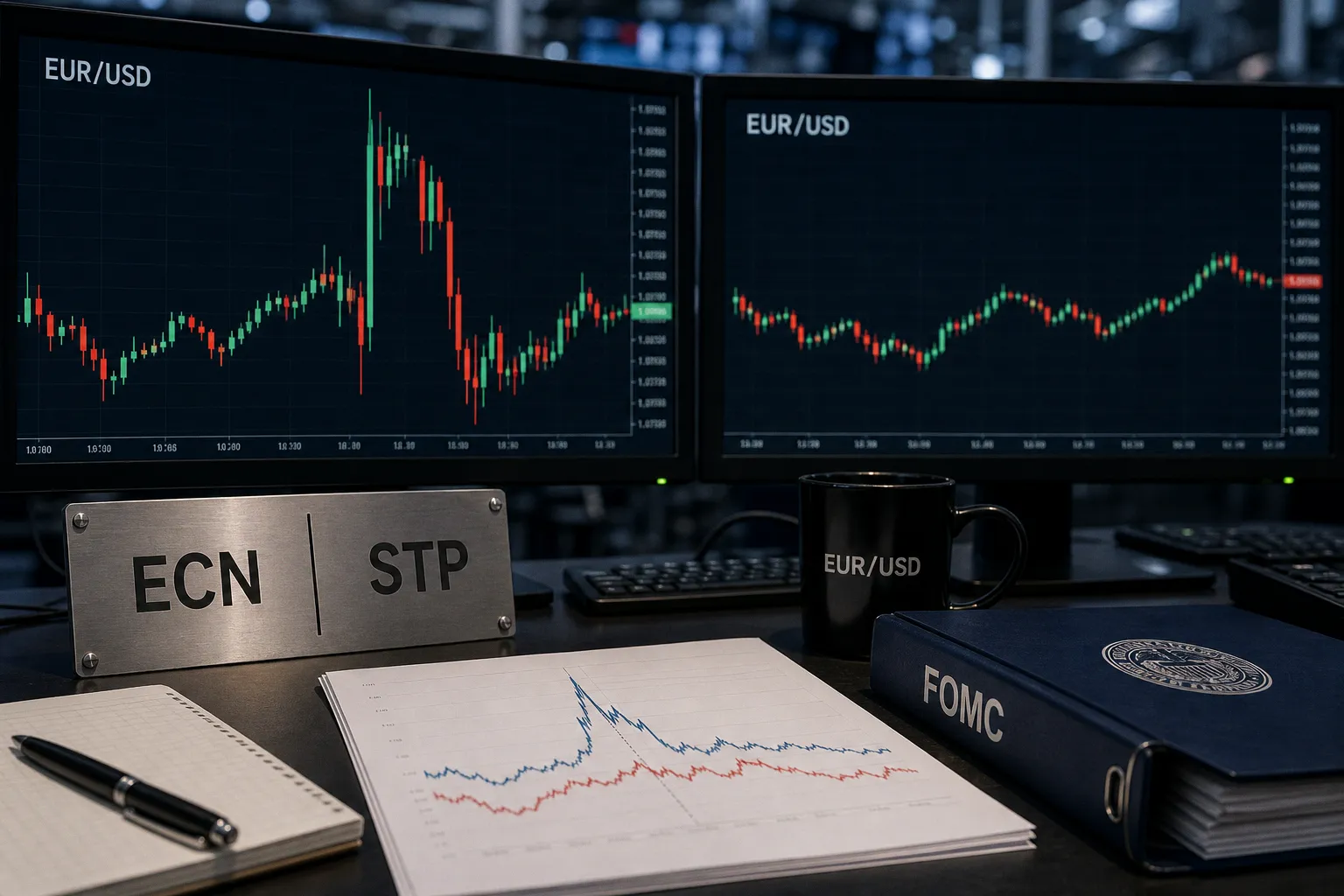
Before any trader concludes that tighter is automatically cheaper, the execution architecture on both sides of the routing decision deserves a closer look. We need to move past the marketing copy and into the mechanics — where the order actually lands, who is providing the liquidity, and how the broker's contractual terms translate into the price you see on screen.
Mechanics of ECN and STP Execution Models
The division between ECN and STP is fundamentally a question of where the price is formed. An ECN (Electronic Communications Network) account connects the trader's order directly to a multilateral pool of liquidity providers — tier-one banks, non-bank market makers, hedge funds — and the price you see is aggregated from those resting orders. There is no dealing desk intermediating, which is why ECN venues can quote raw spreads as tight as 0.0 to 0.5 pips in EUR/USD under normal conditions. The broker charges a separate commission per lot to monetize the route.
An STP (Straight Through Processing) account, by contrast, still routes the order to liquidity providers, but the broker typically adds a fixed or variable markup to the spread before passing the quote to the trader. STP venues therefore quote wider, more stable spreads — often in the 0.8 to 1.5 pip range on EUR/USD during quiet sessions — without charging a per-trade commission. The cost is embedded entirely inside the spread.
When liquidity providers withdraw resting orders ahead of a release, the spread that reappears is the market's risk premium for trading against informed flow — and it appears whether your account is labeled ECN or STP.
These are not absolute categories. Many brokers operate hybrid STP/ECN models that combine routing discipline with selective markup, and the terms "true ECN" or "no dealing desk" are not regulated labels. Whether a venue is genuinely an agency broker or simply a dealing desk rebranded as an STP is something we verify against the execution policy document, not the marketing brochure. The distinction matters because it determines who bears the inventory risk during the moments when risk is priced most aggressively — and that is always the moment a trader is trying to execute.
How Liquidity Depth Impacts EUR/USD Spreads During Volatility
Liquidity is not a constant; it is a function of the order book at a given moment, and the order book is thinnest at the moment the broader market needs it most. During scheduled events — NFP, FOMC, the ECB press conference, eurozone CPI prints — liquidity providers pull their quotes ahead of the release to avoid being picked off by informed flow, and the depth on the book collapses for tens of seconds around the headline. That vacuum is exactly what causes spreads to widen from 0.1 pips to 5, 10, or even more pips across both ECN and STP venues.
The asymmetry between the two models shows up in how they weather that vacuum. ECN accounts, tied to raw interbank pricing, widen more violently and more visibly — the spread you see on screen reflects the actual thin book. STP accounts, cushioned by broker markups, widen less dramatically on the quote, but the cushion is itself a form of hidden cost: the broker is absorbing risk on the markup, and that risk is priced into every fill. We treat both effects as real components of execution cost, not just the visible number on the screen.
Geopolitical shocks outside the FX calendar drive the same withdrawal-of-depth pattern. A surprise sanctions package, an unexpected sovereign downgrade, or an escalating regional conflict can pull resting orders from the book as decisively as any rate decision — and brokers route flow accordingly. Tagged as high-impact events in our watchlist, such headlines trigger the same spread-widening sequence as a central bank surprise. Capital flows are conditioned not just on carry and yield differentials but on whatever is moving the macro tape at that minute.
The practical implication is that traders who benchmark their cost model on calm-session data are building a model for a market that does not exist when they most need tight execution. The spread that matters is the one printed during the event, and both ECN and STP venues will widen — the question is by how much, and whether the broker's execution infrastructure rebuilds depth within seconds or lets the thin book persist for the rest of the session. The rebuild speed is a function of how many liquidity providers the broker has relationships with, the tier of those providers, and the broker's own risk appetite for internalizing flow during a shock. A venue with deep, diversified LP relationships will re-quote tighter faster than one relying on a handful of wholesale providers, and that difference shows up in the weighted-average cost-per-trade metric that we track across consecutive event cycles.
Calculating Total Cost: Raw Spreads Plus Commissions vs Markups
Headline spreads tell you very little without total-cost arithmetic. The decision between ECN and STP, for EUR/USD during news, reduces to a per-trade cost equation that we run on every setup we consider:
ECN total cost per round-turn lot = (raw spread in pips × pip value) + commission
STP total cost per round-turn lot = (quoted spread in pips × pip value) — no commission
| Parameter | ECN (Raw Spread + Commission) | STP (Markup Embedded) |
|---|---|---|
| Typical EUR/USD spread (calm) | 0.0–0.5 pips | 0.8–1.5+ pips |
| Commission per lot (round-turn) | ~$3–$7 at major brokers | $0 |
| Behavior during NFP / FOMC / ECB | Visible widening, can exceed 5–10 pips | Wider but partly cushioned by markup |
| Order routing | Direct to LP aggregate pool | Routed to LPs with broker markup |
| Best-fit volume profile | High-frequency, scalping, news fades | Swing, position, lower frequency |
| Total cost for one standard lot at 1-pip spread | $10 + commission | $10–$15 (all-in) |
For a trader running five to ten round-turn lots per day, the ECN model is almost invariably cheaper, even after the commission is loaded, because the per-pip savings compound quickly through repeated execution. For a trader running a handful of swing trades per week, the STP model is frequently the cleaner choice — the commission savings are negligible, and the all-in spread math is comparable once fills are considered.
A second misreading deserves correction: an ECN account does not guarantee a lower total cost. For low-volume traders, the fixed commission can exceed the spread savings and ECN becomes structurally more expensive. This is precisely why brokers offering both account types tend to funnel higher-tier clients toward ECN and casual traders toward STP — the routing model is calibrated to the volume profile, and the pricing reflects that calibration.
There is also a behavioural trap worth naming. Traders who switch to ECN accounts for the headline spread figure often fail to recalculate total cost after the commission is added, and the per-lot charge is not trivial — at $7 per round-turn, that is equivalent to 0.7 pips of embedded spread. A trader paying 0.2 pips raw plus $7 commission on an ECN account is paying 0.9 pips all-in, which is only marginally cheaper than a well-priced STP account quoting 1.0 pips with zero commission. The advantage materializes at scale, not at a single trade, and that scale threshold is something every trader should calculate for their own volume before committing to an account type.
Methodology for Tracking Spread Widening During News Events
Pairing a venue's quoted spread with its executed spread during a scheduled event is the only honest way to assess the real cost difference. We run the same drill on every broker we evaluate, and the steps translate directly to a MetaTrader 4 or MetaTrader 5 setup that any trader can replicate:
1. Log raw tick data in MT4/MT5 from 30 minutes before through 30 minutes after each release — NFP, FOMC, ECB, and eurozone CPI all qualify as high-impact EUR/USD events.
2. Compute average and median bid-offer spread over 1-minute windows: pre-news, during the print, and the 30 minutes following.
3. Tag the broker by account type — ECN raw, STP markup, or hybrid — and pull the commission schedule from the contract specification.
4. Calculate total cost as (avg spread × pip value) plus commission per lot, normalized to a single round-turn trade.
5. Compare across at least three consecutive releases of the same event to filter out noise from the individual print.
The exercise produces two output metrics worth tracking: spread-at-tick and weighted-average cost-per-trade. Spread-at-tick exposes how often the broker widens beyond a cap; weighted-average cost exposes whether the saved spread on a quiet day is paid back during the volatile day. The trader who only looks at calm-session quotes is benchmarking the wrong hour of the cycle.
The spread you pay during a scheduled release is the only spread that compounds against you — the quiet quotes are decorative.
A spread monitor tool offered by independent third-party platforms (Myfxbook, Forexfactory) is a useful sanity check, but it should be paired with locally logged tick data, because broker-specific routing and last-look arrangements produce per-venue results that aggregated feeds cannot resolve. One additional layer we recommend: log the time-to-fill alongside the spread. A broker may quote a tight ECN spread during an event but execute with 200–400 milliseconds of latency, and in that window the market can move a full pip or more against the position. The cost is not in the spread — it is in the slippage that the spread number does not capture.
Evaluating Broker Execution Policies for High-Frequency Trading
For high-frequency strategies — defined in our context as anything more than a handful of round-turns per day on EUR/USD — the textual execution policy matters more than the marketing tag. We look for explicit language on how the broker handles requotes, slippage, and last-look during news windows. Last-look arrangements in particular can invert the apparent cost structure: an ECN broker that retains last-look discretion can decline to fill at the quoted price during volatility, and the trade goes through at a worse level than the screen showed. The user sees a tight raw spread and never knows the execution price differed from the quote.
The regulatory trail is also material. Brokers domiciled under ASIC, FCA, CySEC, or comparable tier-one regulators are required to publish RTS 27 / RTS 28 execution quality data — order-to-fill ratios, average slippage, and times-to-execution — that lets us verify the venue's claims against the trade tape. Brokers operating offshore with less rigorous reporting may quote tight spreads and commission-free accounts but offer no audit trail. For a fund or an account running meaningful EUR/USD volume, that absence of documentation is itself a cost — and one that surfaces only when a hawkish pivot or a liquidity shock hits the open position.
We also weigh the broker's handling of partial fills and rejection rates during peak volatility. An ECN venue that fills 60 percent of a large order at the quoted price and rejects the remaining 40 percent — or routes it at a worse level — is functionally more expensive than an STP venue that fills the entire order at a wider but consistent price. The execution policy document should state rejection thresholds and partial-fill logic in plain language; brokers that obscure this detail in legal boilerplate are, in our experience, the ones most likely to have something worth hiding. For high-frequency EUR/USD flow, where the edge on any single trade may be measured in fractions of a pip, the integrity of the execution path is the strategy — not an afterthought.
Closing Levels and What to Watch
The macro picture going into the next round of ECB meetings and eurozone CPI prints points to conditions where ECN spreads will widen harder and STP spreads will hold better — but both will cost more than the calm-session quote suggests, and the difference between the two will widen with the magnitude of the surprise. We are watching the following levels to confirm the regime: EUR/USD resistance at the 1.0900–1.0950 band, where offers will cluster ahead of any hawkish pivot, and support at 1.0750, where stops tend to sit. The flow that probes either side during an ECB or Fed event will dictate whether the order book rebuilds within minutes or stays thin for the rest of the session — and that rebuild, not the pre-event spread, is what determines whether ECN or STP earns its keep on the day. Choose the venue based on the volume you actually trade, not the quote you would like to see.